Tuesday, May 13, 2014

Response of “Virtual Bodies and Flickering Signifiers”


In N.Katherine Hayles’s “Virtual Bodies and Flickering Signifiers”, she is mainly discussing about the transition from the concept of “absent/present” to “pattern/randomness” under the era of the information and cyborg age.  But why it is so important to emphasize the shift?  For me, the shift itself may generate a debate in embodiment theory. Does it initiate a new experience of embodiment or completely deny it?
 Generally when talking about embodiment theory, the first thing come to mind is the coupling of cognition and human body. Here the body is no longer a shell purely executing the instructions from brain. Instead, it plays an essential role actively determining the formation of cognition. However, things changed a lot when technology is developed at a breathtaking pace. Without the need of physical forms, we need to take a fresh look at embodiment theory.
Combining with the content in the article, I’d like to firstly summarize and analyze the differences and similarities between before and after the shift in three different aspects. The most obvious difference is from the relationship between the body (the material substrate) and the message (the codes of representation). Hayles makes a very interesting analogy between the human body and traditional printing media, such as books and newspapers. “Like the human body, the book is a form of information transmission and storage that incorporates its encodings in a durable material substrate.”, once the relation between texts and media is built, these two separate things would coexist as a symbiont and can hardly be changed, this can also be applied to the human body.  To be short, the relationship is anti-dualistic, integrated and stable. On the contrary, the link between the media and digital information is not that closely tied. In some cases, the physical entities are even no need to exist. As for the information (e.g. digital texts), although it can be exported into hard drives for permanently storage, you will find that there are no fixed correspondences between the media that are used for visualization (like monitors) and the content. For example, when you are reading an e-book, once you turn to another page, the previous one is no longer there. In other words, what information technologies create is just a temporary mapping relationship.
Secondly, I will talk about the inner interpretations between the body and the message. Unlike digital platforms, the contents of the cognition are supplied by the media when dealing with traditional media and human bodies. According to Lakoff and Johnson’s concept, human’s abstract thinking abilities are built on metaphors. For example, the rose is often a metaphor for love because of the similarities of the beauty and danger. People tend to interpret unfamiliar and obscure things with the aid of what they already understood. Thus, it’s not difficult to find out that the human body is the most familiar thing for people. There are a lot of concepts originally perceived by our bodies, like temperature, distance, etc. With these raw concepts, people then extend them into more advanced and abstract ones. Similarly for books and newspapers, since the printed texts and the paper cannot be separated as a whole, the contents composed of realignments of alphabets are indeed supplied by the media. However, precisely because of the peculiarity of transiency, digital media itself doesn’t rely on such direct mechanism. Even so, we still cannot ignore the similarities. The process of encoding from machine language to high-level language exactly simulates the way that people interprets abstraction from metaphors.
Last but not least, information technologies alter the relation of signified to signifier. This shift is due to the multi-layer hierarchy of computer system. The two ends of the hierarchy need to talk to different objects and they also need to communicate with each other through a series of dynamic interpretations. There is actually no strict boundary between the two.
Hayles summarized these differences into the shift from “absent/present” to “pattern/randomness”. I have to say that the new relation of “pattern/randomness” indeed deviates from the embodiment theory and we all need to admit a possibility that it will completely dominate the world. I understand the fear of abandon of materiality because people have already been living for millions of years in physical world. From the embodiment theory, I personally can realize humans’ complex of their physical bodies. Pure immateriality may make them question their self-existence. For me, I don’t think if there is a way to combine pattern and presence as complementary rather than antagonistic unless they redefine what pattern, presence, embodiment means. Or maybe in the distant future, “posthuman” will get used to it and will not have that complex anymore.

Postscript on the Societies of Control

Deluze was a French philosopher friend and scholar of Focault, also influences by the work of Boudelair and Gides. He was one of the first to register the events of may 1986 in conceptual terms (in response to the students's uprising). Deluze also worked with FĂ©lix Guattari, and produced texts such as Capitalism and Schizophrenia, Anti-Oedipus (1972) and A Thousand Plateaus(1980). He wrote on authors-more or less known and on films by approaching each author and work with a constructivist attitude.

Deleuze dedicated his work to the creation of new philosophical concepts. He was concerned with, the position of the social and political at the core of being, and the difference of transcendental hierarchy. And worked with the nature of thought, identity and time, through the disruption of the canonical tradition of philosophy.


Postscript on the society of control

Deleuze discusses Focault distinction and shift between disciplinary societies to societies of control. Focault analyze these environments of enclosure-especially the factory and the transition from this productive model (of production and of control to other productive models).
He starts with an historical background to illustrate how this shift has happened. 
Disciplinary societies were a model of production and control typical of the 18th and 19th century, that because of crisis of values and institutions from the second world war this model is shifting to the current one: of society of control. 

Disciplinary societies had at their time came as a substitution for a previous production model, the societies of sovereignty at the hand of Napoleon. The role of these societies of sovereignty was to tax, rather than to organize production, and to rule on death, rather than to administer life.

The new phase of control of production given by disciplinary societies, organised and controlled production through various areas of confinement, consisting in the factory, the school, the prison, the hospital, and the barrack (which was the home). The factory was the most important of these areas of confinement because used to be the place where production happened, and the control over the productive process was exemplified.  The enclosed environment of the factory was based on the analogical model of the prison: where you went to work, you were contained for a certain amount of hours, you then clocked out, left and were free until the next day (the action of you physically clocking out is important).


The logic by which these control systems operate: in disciplinary societies is that all the different spaces of enclosure are different from one another. For example,  the factory is a space of enclosure, when you go home you stop being controlled by that environment and you get into the space of enclosure of the home (barrack). When you are finished with in the space of enclosure of the school, you return the one of the barrack and then, and only after you get to the one of the factory, from which you return to the barrack every night. The control from one space of enclosure does not extend to the next, but nevertheless they are inseparable and together they form a system. The control system of the school helps you get to the factory, that then  controls you being able (gives you the ability) to be in  the home-barrack (pay rent), and so on-and this is comparable to a system of geometry, variable and numerical. (depending on the school comes a different factory, and the type of activity of the factory gets you different numbers- or positions that allows in different types of barracks (the factory is intended as the work place and not necessary-A factory in the actual sense).

In this scenario  enclosures are molds but controls are modulations- the various environments (molds) shape the controlled individual- shape the production and the mean of production- which is the individual himself. These are modulated by the degree and nature of control exercised in each- and the control is what will change this cast.With the switch from disciplinary societies to societies of control there is drastic change in the nature of the organism of control and in productive models.
The enclosed entity of the factory (workplace) of disciplinary societies is replaced by the corporation in societies of control (gaseous and immaterial). Changes of productive modes where productivity obtained through modulation of wages  in the factory, is replaced by the modulation of salaries operating through challenges, contexts, and comic group sessions in the corporation (see home depot for example). This change in productive modes implies the switch from the internal control of internal forces: combination of high production and low wages to the productivity model of the corporation based on the modulation of salaries which raises in accordance to rank and merit, and operate through challenges, contexts, and group sessions.

Resistance to control also changed: the one to one confrontation of production against control in disciplinary societies (resistance externalized by the mass resistance of the union), in societies of control is dissipated by portraying rivalry as an healthy form of emulation, motivating forces and putting people in competition with one another, because it seems that productivity is enhanced this way (productivity and not production, because production has ceased to exist). This new externalization of productivity help avoid revolts that were based and built on solidarity-and the modulating factor is salary according to merit.    

All phases that in earlier disciplinary societies where distinct containment, in societies of control are all integrated, and the method of control has adjusted . 

A similar condition translates to education and training replaces schooling (we don't study theories but we operationalize methods), and continuous control replaces the examination. System of control have become integrative and while with disciplinary societies on one was always starting over and went through different phases, from the school to the barrack, and from the barrack to the factory. In societies of control the process is continuous and integrated. 

The trial by Kafka-the disciplinary system
Disciplinary system has also changed and it has switched from the disciplinary system of apparent acquittal to the unlimited postponement of societies of control. The case of Amanda Knox in Italy is an example of how a misunderstanding of apparent acquittal (by counselors operating in a society of control) has led to a conviction for murder. Kafka describes the juridical system reflecting this type of formation in "the trial." In the unlimited postponement the individual is accused of something (he is unaware of what this is). The matter is investigated but he does not know the progress. He is never prosecuted but he is nevertheless punished-with the exclusion from society.


Monday, May 12, 2014

Poetics of Lace

After creating a porcelain lace rabbit house, I became more curious of Bachelards’ Poetics of Space, and the idea of the house being a metaphor for humanness. In the first part of the reading, concerning the nest, he describes the phenomenological similarities between the nest and the home, while reminding us that verbs describing the idea of retreat, relate to animal movements (Balk, flee, burrow, “chicken out”…), thus implying animal qualities that exist within humans. 

In designing my performance/ installation, Nikoukira (The homemaker), the idea of building a house structure out of the methodological movements of rolling out porcelain clay onto lace press molds, was in many ways similar to the primitive movements of how an animal creates its nest. Using my own hands to laboriously and repeatedly press clay into the molds to create hundreds of tiles can be considered a primitive gesture.


Bachelard brings to our attention Van Gogh’s paintings of cottages and nests and how, “for a painter, it is probably twice as interesting if while painting a nest, he dreams of a cottage and while painting a cottage, he dreams of a nest.” (98) I’m interested in this sort of reflectiveness that coincides with ones lived experience and how as humans, we can’t help but project our emotions onto our relationships with objects and our experience. Similar to Visher’s philosophy on empathy in our earlier readings, phenomenology seeks to project ourselves and give meaning into the objects and spaces of our environment.

I was also struck by his statement, “dreams of a garment-house are not unfamiliar to those who indulge in the imaginary exercise of the function of inhabiting,” for the mere fact that I have essentially made a “garment-house” if one considers the traditional use of lace.  This brings up he notion of the function of inhabiting in our cloths and in our bodies. 

He also brings up the notion of the house/ nest as a protective enclosure and introduces the home of snails and crustaceans— the shell. If one considers the course shell like structure of my porcelain tiles, one can be reminded of the inhabitants of seashells and mollusks. Or —more accurately in reference to my work—of one who makes a home out of broken shells. This, and Bachelards idea of how when we discover a nest, it takes us back to our childhoods, or a childhood we wish we had….and that “ if we return to the old home as to a nest, it is because memories are dreams, because the home of other days has become a great image of lost intimacy.” (100)


Finding moments of humanness, even when not depicted in the literal representation of a house, is an integral component in this reading, and generally, what triggers many people the desire to create art.

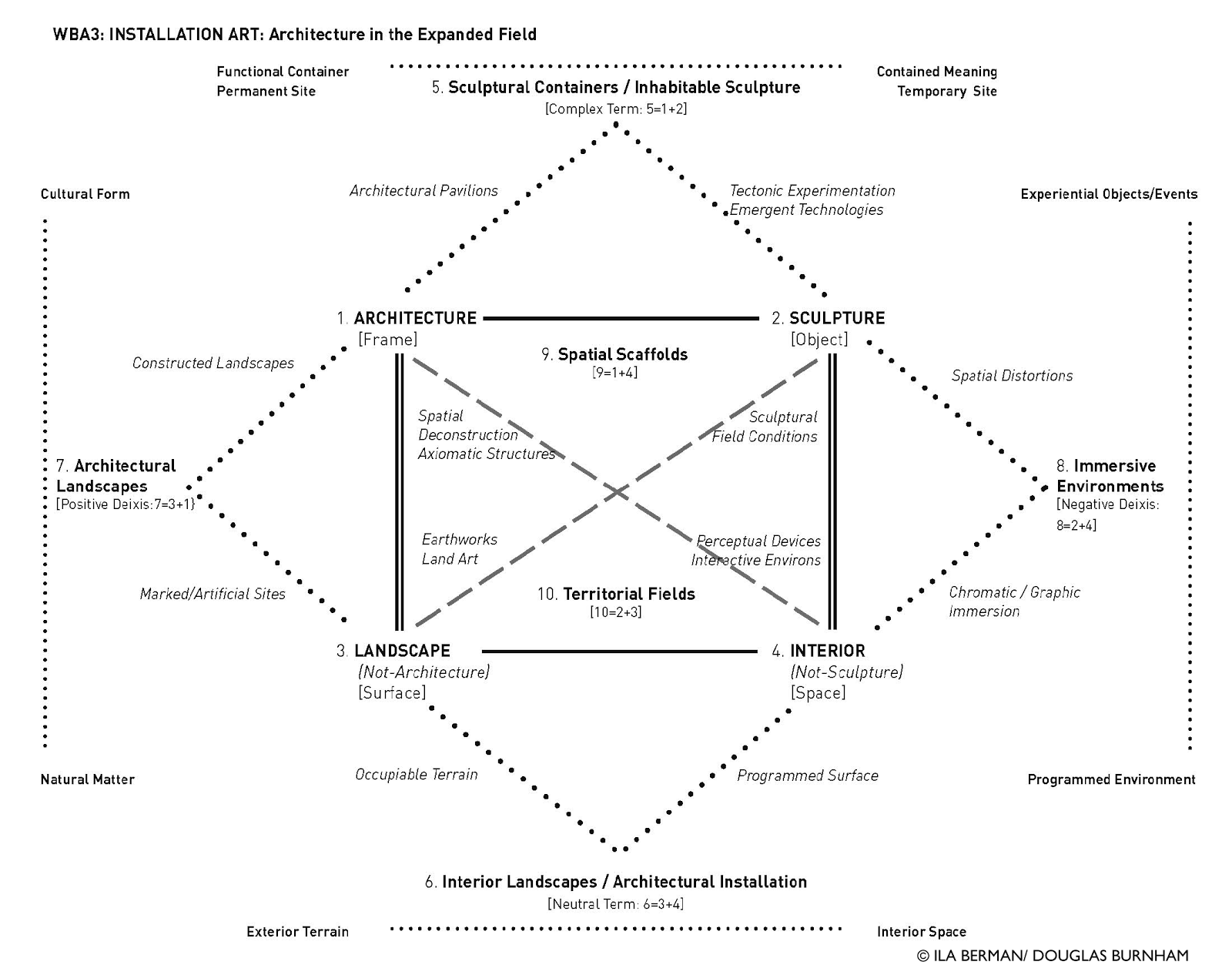
Expanding the expanded field

Earlier in the semester’s discussion of “Sculpture and the Expanded Field,” we talked about the progression of Rosalind Krauss’s understanding of sculpture from the classical era to the early 70’s:
“Over the last ten years rather surprising things have come to be called sculpture: narrow corridors with TV monitors at the ends; large photographs documenting country hikes; mirrors placed at strange angles in ordinary rooms; temporary lines cut into the floor of the desert.” (Krauss 31)
In the article, Krauss explains how we understand sculpture as a historically bounded category, not a universal one, which has it’s own internal logic, rules, and rules that can be broken.
In a traditional sense, she describes the logic of sculpture as inseparable from the logic of the monument, and that it sits in a particular place and speaks in a symbolical tongue about the meaning or use of that place. At this point she describes the turning point of sculpture of the late 19th century, and how the idea of the sculpture as monument begins to fade to something “largely self referential” that doesn’t require site specificity.
By the early 60’s she describes sculpture as “what was on or in front of the building that was not the building, or what was in the landscape that was not the landscape.”
In a very logical diagram, she describes her theory that sculpture, in its contemporary (late 70’s) existence falls into four categories— site construction, axiomatic structures, marked sites, and sculpture.
I am curious if Krauss’s view is still relevant to today's practices, as well as what sort of logical bubble she would put my practice in. I recently found this diagram of a further expanded field and thought it was with sharing. Here is Douglas Burnham’s updated version, relating more specifically to installation art:

Sunday, May 11, 2014

The unbearable lightness

 In her book How We became Post-human, Hayles has examined the notion of  “how information lost its body, that is, how it came to be conceptualised as an entity separate from the material forms in which it is thought to be embedded”. She further suggests that as technology and the overall digital revolution involved, we are in the situation where the pattern/randomness binary is deemed to have privileges over absent/present. Information came to be seen as an abstract and absolute “truth” that is more essential than material instantiation. 

Hayles primarily uses contemporary literature, especially the cyberpunk/virtual reality to illustrate her points. However I couldn’t help but contemplating how it would apply to the world I’m living in. Moving from city to city, country to country, I have filled in countless application forms for new IDs. As someone who has a “wandering mind”, I lost my cards and passport more than once (six times in eight years, to be precise ). It was one of the most frustrating experience when it happened since it left me without any proof of who I am in the foreign land. The only way to get a replacement is to file more forms as well as provide other identification documents. The whole process of regaining my legitimate identity is clearly a information-dominated one, during which my body is discarded (except for the photos I’ve taken, which can be alternated anyway since it is digitised). Moreover, when going through the customs at the airport, I often get nervous when an officer starts examining my passport and giving me skeptical glances, as if he is matching the information to its material manifestation and the latter is less convincing. Apparently, the “I” that is encoded as informational patterns in the cyberspace that is regarded as more authentic and reliable than my own bodily presence. The society we inhabit seems to privilege the abstract as the Real, and downplay the materiality. One of the example used in the reading is Neuromancer, a novel written in 1984 by William Gibson, which push the post-human condition into its extreme.  The body existed outside of the cyberspace, is only considered as “meat”, of which the only function is to serve as a container for his consciousness, and “information is the putative origin, physicality the derivative manifestation”. The post-human body is just “data made flesh”.  As technology keeps advancing at today’s rate as well as seems to be heading toward this direction, is this our inevitable end? 


I found this Hayles’s writing can be seen as a cautionary tale for the information age where we are constantly overwhelmed by the speed and variety of technical development, trying our best to adopt and adapt new technologies, and for someone they are striving to make something better. Burke points out in his essay “Definition of man” that the last of the five attributes of what make us human is the notion that we are the only animal that are “rotten with perfection”. He quotes Freud saying that “the repressive instinct never cease to strive after it complete satisfaction”.  There is an “impulse” dwelled in us towards perfection.  I was wondering about why there are desires and interests in creating virtual reality,  to be a brain in a Cyborg or to upload one’s consciousness onto a machine. After going through novels and movies with related subject, one plausible reason I found is the fact that human body is considered to be the weakest link - vulnerable, lack of strength and mortal. The fear of death as well as the wishes of being omnipotent and immortal are rather primitive. However, in today’s age, empowered by technology, we’ve achieved some progress and opened up more potentials.  That being said,  any kind of technological development comes at a price, and sometimes it’s a price that we can’t afford. Technology determinism may become a self-fulfilling prophecy. However, even if happens, I’d like to believe that there will always be a way out of the matrix, getting unplugged.


Wednesday, May 7, 2014

Piss Christ

conversation today reminded me of an image I found recently.  This illustration was done by a blogger who was influenced by Serano's use of bodily fluids.